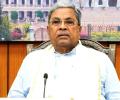
Karnataka Chief Minister Siddaramaiah has clarified his remarks on the Pahalgam terror attack, saying he did not call for no war with Pakistan, but emphasized that war should only be a last resort. His comments, which were played up by Pakistan media, have sparked criticism from the BJP, which accused him of acting like a "puppet" of an enemy nation.

US President Donald Trump reiterated his claim at the UN General Assembly that he stopped the conflict between India and Pakistan, while also criticizing the UN's lack of involvement in resolving global conflicts.
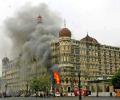
'The preparedness of our defence forces and positioning of intelligence assets were very different in 2008, so we had to rebuild our assets and preparedness.'
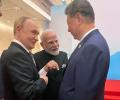
'One Chinese interlocutor said India should realise that "China can do without India, but India could not do without China", pointing to its inability to do without Chinese intermediates and components,' former foreign secretary Shyam Saran discovers on a visit to China.

'Shock, confusion, and paralysis reigned.' 'Pakistan was caught in a most embarrassing situation. It could neither claim credit for the operation nor admit to a dismal intelligence failure and lack of army preparedness.'
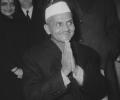
The high point of the 19 Shastri months was the 22-day war that he fought against great odds and won in principle, even if military historians often call it a stalemate. Pakistan saw a great opportunity to conquer Kashmir and lost. It was the last time they had the relative strength militarily and diplomatically to take Kashmir. Shastri's resolve buried that dream forever, points out Shekhar Gupta.
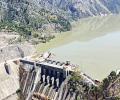
Pakistan has halted the construction of contentious canals in Punjab province after India suspended the Indus Waters Treaty following a deadly terrorist attack in Kashmir. The decision to suspend the canals project was made after Prime Minister Shehbaz Sharif met with PPP chairman Bilawal Bhutto-Zardari and agreed to address the concerns of Sindh province, where the project had sparked protests. The canals project, aimed at irrigating the desert region in Punjab, was seen as a threat to water resources in Sindh. Both sides have agreed to seek consensus on the issue in the Council of Common Interests (CCI), a high-powered inter-provincial body. Meanwhile, Pakistan has reiterated the importance of the Indus Water Treaty for its water security and economy, and condemned India's move to suspend it.

The steep 50 per cent tariffs imposed by the United States on Indian goods are largely a result of President Donald Trump's 'personal pique' at not being allowed to mediate in the India-Pakistan conflict, according to a recent report by American multinational investment bank and financial services company Jefferies.

AIMIM chief Asaduddin Owaisi slammed Pakistani politician Bilawal Bhutto-Zardari for his "blood would flow in rivers" remark and called former cricketer Shahid Afridi a "joker" for his comment on the Pahalgam terror attack. Owaisi also supported India's decision to suspend the Indus Waters Treaty and called for Pakistan to be placed on the FATF grey list. He also advocated for cyber attacks against Pakistan.
When the government chooses to either ignore or use identity documents only when it suits them, it shakes people's sense of stability, notes Shyam G Menon.

India on Thursday night swiftly foiled Pakistan's attempts to hit various key Indian installations including military stations at Jammu, Pathankot and Udhampur with drones and missiles, the defence ministry said.

Trump also repeated his claim that seven fighter jets or more were shot down during the hostilities.

Sharif, the three-time former premier, said that there is a need for all the political parties to sit together and form a government to pull Pakistan out of its difficulties.

'Punjab floods are a calamity.' 'Right from Firozpur to Amritsar nearly 1 lakh homes have been completely damaged due to floods.'concern about the state of affairs.

'The people who were protesting and getting violent were all in the age group of 14-25.'

A Bangladeshi court has sent 16 people, including veterans of the 1971 Liberation War, to jail under the Anti-Terrorism Act after a mob disrupted their public discussion.
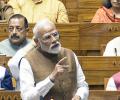
Prime Minister Narendra Modi defended India's actions against terrorism, stating no country stopped India and criticizing the Congress party for not supporting the armed forces. He highlighted the success of Operation Sindoor and warned Pakistan against further misadventures.
'There were deep discussions within the Sangh Parivar before this decision was made.' 'They were convinced, and only then did the Modi government proceed with the caste census.'
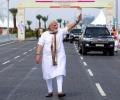
Let there be no doubt that Modi in these 24 years so far has reshaped politics and governance considerably, if not completely, asserts Nilanjan Mukhopadhyay, author, Narendra Modi: The Man, The Times.
When the government chooses to either ignore or use identity documents only when it suits them, it shakes people's sense of stability, notes Shyam G Menon.
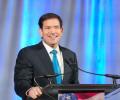
Rubio mentioned the recent conflict between India and Pakistan that President Donald Trump has repeatedly claimed he solved.
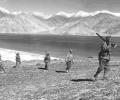
As India and China continue to face off across the Himalayas six decades later, the echoes of that earlier conflict remain unmistakable. The core of China's sensitivity lies not in maps or mountain passes, but in its perception of sovereignty over Tibet, points out Dr Kumar.
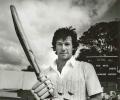
The Imran Khan enclosure, which is one of the VIP stands in the stadium, has been a permanent fixture at the venue since 1992.
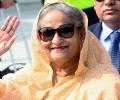
The Anti-Discrimination Student Movement (SAD), which led protests against Bangladesh Prime Minister Sheikh Hasina, has launched itself as a political party called the National Citizen Party (NCP). The new party, which aims to 'dismantle constitutional autocracy' and establish a 'second republic,' has pledged to create a 'solely Bangladesh-oriented' political system, with no room for 'pro-India and pro-Pakistan politics.' The NCP's inaugural rally was attended by representatives of various political parties, including the Bangladesh Nationalist Party (BNP), Jamaat-e-Islami, and envoys from the Vatican and Pakistan.

'Operation Sindoor is still ongoing. The Prime Minister himself said that blood and water cannot flow together, that talks and terrorism cannot go together. So how can we have a cricket match with a country that indulges in terrorism?'
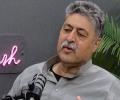
Former separatist leader Bilal Gani Lone criticizes the Hurriyat Conference for its irrelevance and Pakistan for creating problems in Jammu and Kashmir, urging a new approach for the region's future.

Congress leader Sonia Gandhi criticizes the Modi government's stance on Palestine, calling it a 'profound silence' and an abdication of humanity and morality. She argues that India needs to demonstrate leadership on the issue and that the government's actions are driven by personal friendship rather than constitutional values or strategic interests.

Khan also insisted on protecting 'Form 45' to guard the people's mandate and expressed confidence over his victory, saying, "no force can defeat an idea whose time has come."

Pakistan's sensational javelin thrower Arshad Nadeem who won the country's first individual Olympics gold in 40 years is being showered with cash awards by Punjab and other provincial governments and organisations.

A big question mark is on whether Shashi Tharoor, who had led the delegation to the US among other countries, will be picked as speaker by the Congress, as the seasoned Lok Sabha member's enthusiastic endorsement of the government's action following the terror attack has soured his ties with his party.
Thailand and Cambodia have for the third consecutive day witnessed clashes at the border that left over 30 dead and more than 1,50,000 displaced.
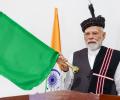
In the last 11 years, India and the world witnessed what he stood for, what he promised and did not deliver, and what he actually stood for and practised without fearing how history would judge him. Modi's tenure has been punctuated with headline-grabbing decisions, symbolic gestures, and stage-managed moments that continue to define his leadership and India's politics, points out Ramesh Menon.

The Congress party has criticized Prime Minister Narendra Modi's description of India and the US as 'natural partners,' citing President Trump's claims of using trade as leverage in India-Pakistan relations. The remarks come amid ongoing trade negotiations and fluctuating relations between the two countries.
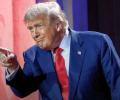
Since May 10, when Trump announced on social media that India and Pakistan had agreed to a "full and immediate" ceasefire after a "long night" of talks mediated by Washington, he has repeated his claim on several occasions.
China firmly opposes the Trump administration's 50 percent tariffs on India as it is "unfair and unreasonable" and New Delhi and Beijing should scale up economic ties to jointly counter the challenge, Chinese ambassador Xu Feihong said on Monday.

INDIA bloc parties are set to raise issues such as the Pahalgam attack, US President Trump's claims of brokering a ceasefire, and concerns over electoral roll revisions in Bihar during the Parliament's Monsoon session.

Defence Minister Rajnath Singh stated India's readiness to assist Pakistan in combating terrorism if it cannot act on its own, highlighting Operation Sindoor as a demonstration of India's capabilities. He also criticized Pakistan's appointment to a UN counter-terrorism committee.
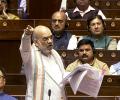
Home Minister Amit Shah stated in the Rajya Sabha that the terrorists responsible for the Pahalgam attack were killed in Operation Mahadev. He also criticized the Congress party's stance on national security.
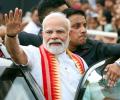
Prime Minister Narendra Modi asserted his commitment to protecting the interests of farmers, cattle-rearers, and small-scale industries amid increasing pressure from potential US tariffs. He also emphasized the importance of using 'made in India' goods.

Glimpses from India and around the world that will make you smile and cry.
 © 2026 Rediff.com - Advertise with us - Disclaimer - Privacy Policy - Sitemap - Feedback - About us - Terms of use - Grievances